Every freelancer and small business owner knows this moment: you download an invoice, it arrives as invoice_scan_final_2.pdf, you tell yourself you will rename it later, and three months later you are searching your Downloads folder before a tax deadline.
The solution is to automatically rename invoices at the source, the moment they arrive, before they pile up. This guide covers 5 tools that do exactly that: what each one is good at, who it is for, and what it costs.
What “automatically rename PDF invoices” actually means
Before comparing tools, it helps to understand two different approaches:
Rule-based renaming: you define patterns (“if the filename contains ‘invoice’, rename it to X”), the tool applies them. Fast to set up for predictable invoice formats, breaks when formats change.
Content-based renaming: the tool reads the PDF, extracts vendor name, date, invoice number, and builds the filename from that. Works on any invoice format without manual rules.
Most of the tools below use content-based renaming. That is the approach that actually scales. Once documents are renamed automatically, automating the full document filing workflow is the logical next step.
5 Tools to Rename PDF Invoices Automatically
Here are the tools that can rename PDF invoices automatically, ranging from zero-touch cloud automation to rule-based desktop apps.
1. Filently: Best for Google Drive users who want zero-touch automation
Platform: Web / Google Drive (Dropbox and OneDrive coming soon) Price: First 25 documents free, then from $6/month billed annually Best for: Freelancers and small businesses receiving invoices regularly
Filently connects to your Google Drive and renames incoming documents automatically. It reads the PDF content (vendor name, date, invoice number, amount) and applies a naming convention to each file without you touching it.
The naming convention is fully configurable. Filently learns from your existing folder structure and file names, or you define it yourself from scratch. Want the invoice amount in the filename? You can include it. Prefer a different date format or separator? That is up to you. The system applies whatever convention you set, consistently, to every document that arrives.
What that looks like in practice: a supplier sends invoice.pdf. You forward the email to your Filently address. Within seconds it appears in your Finance folder as 2026-03-15_AcmeCorp_Invoice-1052_480USD.pdf, or whatever format you have configured. No rule to write, no tool to open.
The difference from every other tool on this list: Filently runs continuously in the background. Files get processed the moment they arrive, whether you are at your desk or not.
| Pros | Cons |
|---|---|
| Fully automatic, no manual triggers | Requires Google Drive (Dropbox/OneDrive coming soon) |
| Naming convention fully configurable, or learned from existing files | Subscription after 25 free documents |
| Reads PDF content including amounts, dates, vendor names | Not for one-time bulk renames of old files |
| GDPR-compliant, CASA Tier 2 certified |
Start free with Filently → First 25 documents free, no credit card needed.
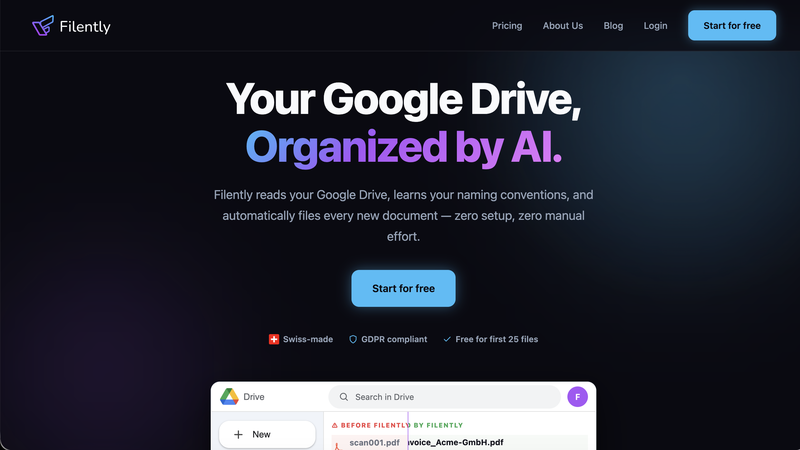
Website: filently.com
2. File Juggler: Best for Windows users who want rule-based automation
Platform: Windows only Price: $40 one-time purchase, 30-day free trial available Best for: Windows users who receive invoices in predictable formats
File Juggler monitors folders and applies rules to incoming files. You define a rule (“if a PDF arrives in this folder, read the text inside and rename it using the invoice number”), and it runs automatically.
It works well when your invoices come from consistent sources: same layout, same vendors. If you receive invoices from dozens of different suppliers with different formats, the rules need more maintenance.
| Pros | Cons |
|---|---|
| Simple rule setup, no coding required | Windows only |
| Works on any file type, not just PDFs | Rules break if invoice formats change |
| One-time purchase ($40) | Requires manual setup per rule |
| 30-day free trial | Not cloud-connected |
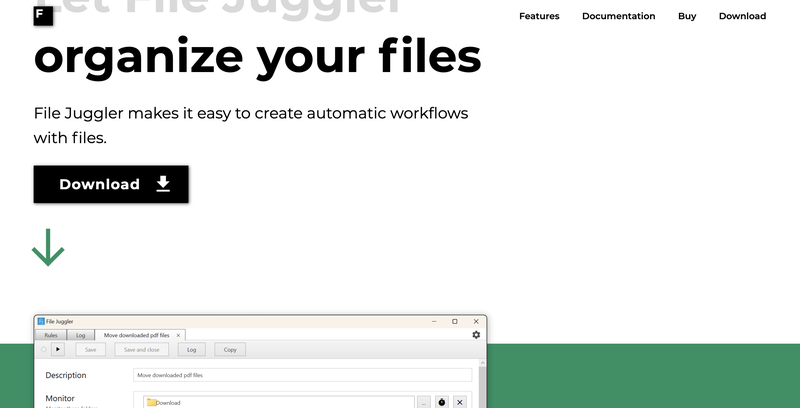
Website: filejuggler.com
3. Hazel: Best for macOS users who want rule-based automation
Platform: macOS 12 (Monterey) or later Price: One-time purchase, around $42 USD Best for: Mac users who want a flexible, scriptable automation tool
Hazel is the macOS equivalent of File Juggler. It monitors folders and applies rules , including reading PDF content to extract invoice data for renaming. Its strength is deep macOS integration and scriptability: you can trigger AppleScripts or Shortcuts as part of a rule.
If your invoices are scanned images rather than text PDFs, Hazel 6 reads them directly using built-in on-the-fly text recognition, no separate OCR tool needed.
A typical setup: Hazel watches your Downloads folder. When a PDF arrives that contains the word “Invoice”, it extracts the client name and invoice number, renames the file to [ClientName]-[InvoiceNumber].pdf, and moves it to the correct client folder. You can extend this with an AppleScript that simultaneously logs the invoice in a spreadsheet.
| Pros | Cons |
|---|---|
| One-time purchase | macOS only |
| Highly scriptable and flexible | Rules require setup and maintenance |
| Built-in OCR for scanned PDFs (v6+) | AppleScript knowledge needed for advanced rules |
| Large community and documentation |
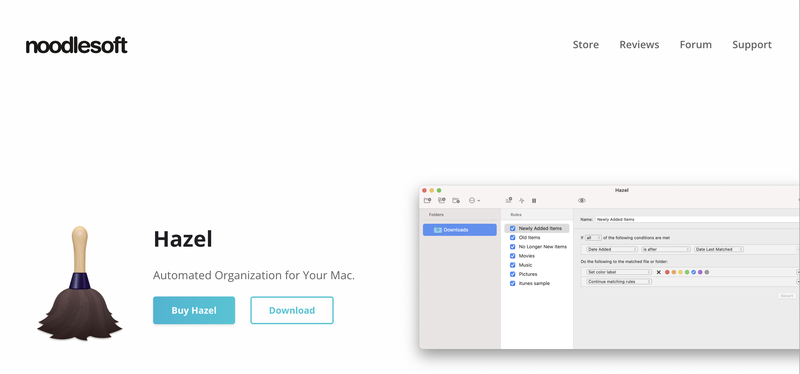
Website: noodlesoft.com
4. Docparser + Zapier: Best for teams that need data extraction alongside renaming
Platform: Web (cloud-based) Price: From around $39/month, 14-day free trial Best for: Teams processing invoices at scale with existing automation tools
Docparser extracts structured data from PDFs: invoice number, vendor, amount, due date, using templates you define. It does not rename files directly. The renaming happens in a second step: Docparser passes the extracted data to Zapier or Make, which then renames the file and saves it to your cloud storage.
The setup requires more steps than any other tool on this list: create a parsing template in Docparser, build a Zapier or Make workflow to handle the renaming and filing. But it goes further than renaming: the same extracted data can simultaneously feed into a spreadsheet, CRM, or accounting tool.
| Pros | Cons |
|---|---|
| Extracts structured data, not just filenames | Renaming requires Zapier/Make; Docparser alone cannot rename files |
| Integrates with Zapier, Make, and hundreds of apps | Monthly subscription for both Docparser and automation tool |
| No-code interface for templates | More setup than standalone tools |
| Good for shared team workflows |
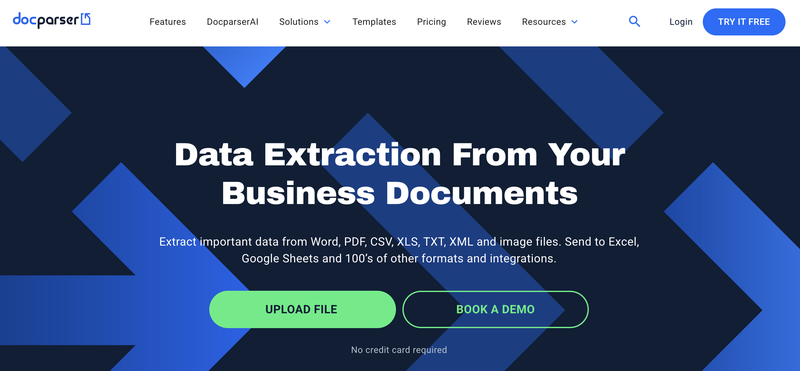
Website: docparser.com
5. Dext: Best for freelancers and small businesses who use accounting software
Platform: Web, mobile app (iOS and Android) Price: From $25.21/month (billed annually), 14-day free trial Best for: Freelancers, bookkeepers and small businesses who feed invoices into Xero, QuickBooks or Sage
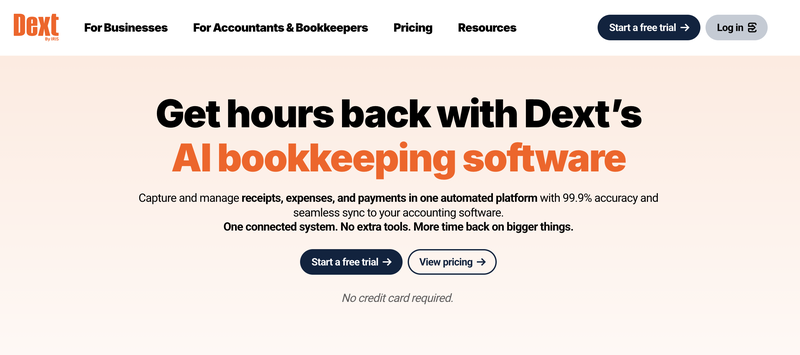
Dext does not rename PDF files in the traditional sense. It solves a related but different problem: getting invoice data out of PDFs and into your accounting software automatically. You forward an invoice to Dext, it extracts vendor, amount, date and tax, and pushes that data directly to Xero, QuickBooks or Sage, without manual entry.
The tradeoff is that documents live inside Dext’s system, not in your own Google Drive or folder structure. If your goal is a clean, consistently named file in cloud storage, Dext is not the right tool. If your goal is to stop manually entering invoice data into your accounting software, it is one of the best tools available.
For freelancers and small businesses who use Xero or QuickBooks, the honest answer is often: use both. Filently for clean filenames and filing in Google Drive, Dext for pushing the data into your books. They solve different parts of the same problem.
| Pros | Cons |
|---|---|
| 99.9% OCR accuracy on invoices and receipts | Documents live in Dext, not in your own cloud storage |
| Direct integration with Xero, QuickBooks, Sage | Monthly subscription |
| Mobile app for capturing receipts on the go | Pricing increases as team grows |
| 14-day free trial | Customer support reported as slow by some users |
Website: dext.com
Quick Comparison
| Tool | Platform | Price | Best for | Setup effort |
|---|---|---|---|---|
| Filently ⭐ | Web / Google Drive | From $6/month | Ongoing automation, any invoice format | Very low |
| File Juggler | Windows | $40 one-time | Rule-based, predictable formats | Medium |
| Hazel | macOS | ~$42 one-time | Scriptable Mac automation | Medium |
| Docparser + Zapier | Web | From $39/month + Zapier | Teams, data extraction + renaming | High |
| Dext | Web / Mobile | From $25/month | Accounting integration, receipt capture | Low |
⭐ First 25 documents free , no credit card needed
Which tool is right for you?
If you use Google Drive and want it to just work: Filently is the right starting point. No rules to configure, no batches to run. Files get renamed when they arrive.
If you are on Windows and your invoices come from consistent sources: File Juggler is a solid one-time purchase. Set up the rules once, let it run.
If you are on macOS and want maximum flexibility: Hazel gives you more control than any other tool, especially if you are comfortable with scripting.
If your team needs the invoice data in other systems too: Docparser extracts the data and can push it to spreadsheets, CRMs, or accounting tools alongside renaming.
If you use Xero, QuickBooks or Sage and want invoice data in your books automatically: Dext is built exactly for this. It extracts the data and pushes it to your accounting software, though note that documents live in Dext, not in your own Google Drive.
For most freelancers and small business owners dealing with ongoing invoice volumes, Filently removes the most friction: nothing to configure, nothing to remember to run, and the first 25 documents are free. Our guide on automating document filing covers how the full setup works.
Frequently Asked Questions
How do I rename a PDF invoice file automatically?
The simplest way is to use a tool that reads the PDF content and builds the filename from what it finds inside. Filently does this automatically when you connect it to Google Drive, no manual steps, no rules to configure. For a one-time batch, tools like File Juggler (Windows) or Hazel (macOS) let you set up rules that run whenever new files arrive in a folder.
Can I rename multiple PDF invoices at once with different names?
Yes: content-based tools like Filently, File Juggler, Hazel, and Docparser can process batches of invoices and give each one a different name based on its content. The key is that each PDF needs readable text (or OCR) so the tool can extract vendor name, invoice number, and date from each file individually.
What is the best naming convention for invoice files?
The format that works best for sorting and searching is YYYY-MM-DD_VendorName_Invoice-Number.pdf, for example 2026-03-15_AcmeCorp_Invoice-1052.pdf. Date first ensures files sort chronologically. Vendor name and invoice number make individual files instantly findable. Our guide on file naming conventions
covers the full approach.
How do I automate invoice naming for new client folders?
Set up a folder structure first (Clients > ClientName > Invoices), then connect a tool to watch the relevant folder or email inbox. Filently handles both the naming and the filing automatically: an invoice arrives, gets renamed, and lands in the right client folder without manual steps. For more complex setups with existing tools, Docparser with a Zapier workflow can route invoices to different folders based on vendor name.
Is it safe to let a tool read my PDF invoices automatically?
It depends on the tool. Filently processes documents within your own Google Drive and never stores copies on its servers. File Juggler and Hazel run locally on your computer, so documents never leave your machine. Dext and Docparser process documents in their own cloud, which is worth considering for sensitive financial data. Both are GDPR-compliant but documents do not stay in your own storage.
Start renaming PDF invoices automatically with Filently → First 25 documents free, no credit card needed.