Human-in-the-loop AI is a system where the AI handles the repetitive, high-volume work and a person provides final judgment on the output. The AI processes. The human verifies.
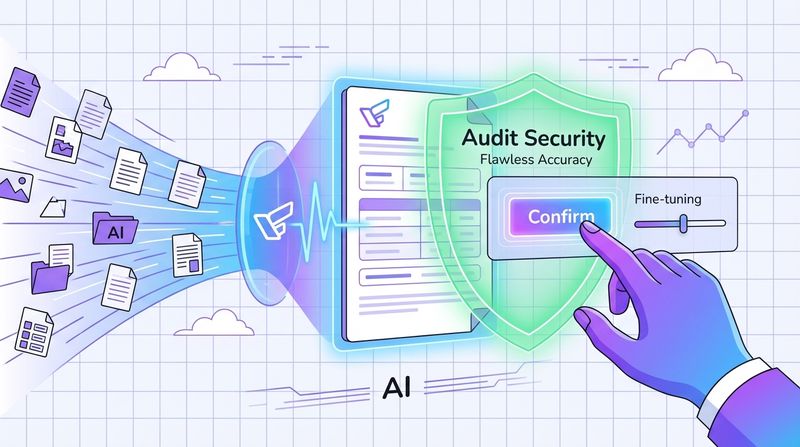
It’s not a compromise between automation and manual work. It’s a deliberate design choice, and one that tends to produce better outcomes than either approach on its own.
Why Human-in-the-Loop AI Matters
For anyone managing invoices, receipts, contracts, or client files, the volume of incoming documents creates a real operational problem. Manual processing is slow and generates errors. Fully automated systems are fast but require trust most people don’t have in them yet, and for good reason, since they do make mistakes.
A human-in-the-loop system takes a different approach. The AI handles the bulk of the work (reading documents, suggesting names, proposing folder locations) and a person reviews and confirms. You get the speed of automation without handing over control.
What Each Approach Actually Delivers
| Aspect | Manual | Fully Automated AI | Human-in-the-Loop |
|---|---|---|---|
| Accuracy | Error-prone, especially at volume | High, but fails on unusual inputs | Highest: human catches what AI misses |
| Speed | Slow, scales badly | Very fast | Near-AI speed with brief review step |
| Cost | High labour cost over time | Subscription or usage-based, lower labour cost | Subscription cost plus minimal review time |
| Trust | Depends on the individual | Hard to trust a black box | High: you always have final say |
The HITL model avoids the main failure modes of the other two approaches. You don’t lose hours to manual processing, and you don’t have to trust an automated system you can’t inspect.
For a broader look at how AI fits into document management, our guide to an AI document management system covers the full picture.
How Human-in-the-Loop AI Works
The reason most people hesitate to hand document filing over to an automated system is straightforward: they’ve seen what happens when software makes a wrong call without anyone there to catch it. A contract in the wrong client folder. A receipt categorized incorrectly. A file named in a way that makes it unfindable six months later.
Human-in-the-loop systems are built around this concern. The AI presents its work, and you confirm before anything is finalized. Your involvement isn’t an afterthought. It’s the mechanism that makes the system reliable.
Your Role as the Final Check
Consider organizing a year’s worth of business receipts. Most are standard and the AI handles them without issue. A handful are handwritten, faded, or from unfamiliar vendors: exactly the kind of inputs that trip up automated systems.
In a human-in-the-loop workflow:
- The AI processes the bulk. Standard receipts get read, named, and sorted in seconds.
- Exceptions get flagged. Anything the system isn’t confident about gets set aside for review rather than filed with a guess.
- You review only what needs attention. A few minutes to check the flagged items catches the errors before they become problems.
This review step does more than catch mistakes. Every correction teaches the system. The AI learns from your decisions, which means the flagged exceptions get fewer and fewer over time.
Each correction refines the AI’s model of how you work. The system gradually adapts to your specific documents, categories, and naming preferences, becoming more accurate the longer you use it.
From Correction to Confidence
This feedback loop is what makes HITL systems genuinely trustworthy over time. You’re not just checking output. You’re actively improving the system’s accuracy. And because you always have final say, the quality of your records stays consistent regardless of document volume.
Benefits of Human-in-the-Loop AI
The practical benefit of a human-in-the-loop system is time. Not a marginal amount, but a genuine reduction in the hours spent on document administration each week.
Here’s a concrete example. Prepping for end-of-year taxes means going through a year’s worth of digital receipts: opening each file, figuring out what it is, renaming it, and moving it to the right folder. Done manually, that’s an afternoon or more.
With a HITL system:
- Before: 4–5 hours of manual sorting, renaming, and organizing
- After: The AI does the initial sort in minutes. You spend 15–20 minutes reviewing and confirming.
The time savings are real, but the less obvious benefit is reduced cognitive load. You stop carrying the background anxiety of knowing a filing backlog exists.
The Efficiency Extends Beyond Filing
When documents are organized consistently and reliably, everything downstream gets faster too. Bookkeeping takes less time. Project handovers are smoother. Audit preparation goes from a scramble to a search.
Automation handles the repetitive parts. Your attention goes to the decisions that actually require judgment.
Human-in-the-Loop in Practice
Invoice Processing for Accounting Teams
For accounting teams, the volume of invoices creates a constant processing bottleneck. Manual data entry is slow and generates errors. A wrong figure or misread date compounds quickly across hundreds of documents.
A HITL approach changes the workflow:
- The AI scans each invoice, extracts vendor name, invoice number, date, and amount, and files it automatically.
- Anything with a low confidence score (a smudged figure, an unusual format) gets flagged for review.
- The accountant reviews exceptions rather than processing everything from scratch.
Processing times drop significantly. The accountant’s role shifts from data entry to quality control, which is a better use of their expertise.
Document Management for Legal Teams
Legal work generates large volumes of documents where accuracy is non-negotiable. A misplaced contract or a misfiled piece of evidence isn’t just an inconvenience.
Human-in-the-loop AI is well suited to this environment because it combines speed with a built-in checkpoint. The AI handles classification and retrieval at scale. Legal professionals review and confirm before anything is treated as final. Oversight isn’t an optional extra. It’s part of the process by design.
How Filently Applies the Human-in-the-Loop Model
Filently is built around this model. When a document arrives in your Google Drive, Filently reads it, proposes a name based on your naming conventions, and suggests a folder location. From there, you decide what happens next.
You Are Always in Control
You can approve the suggestion as-is, adjust the name or location, or override it entirely. Filently offers three processing modes: fully automatic filing, manual confirmation where you approve each decision, and confidence-based processing where it only asks for confirmation when its certainty drops below a threshold you set. Every correction you make feeds back into the system. Over time, Filently’s suggestions get more accurate because they’re shaped by your actual filing behavior, not a generic template.
This means the review step gets faster the longer you use it. The system learns what “correct” looks like for your specific documents and filing structure.
Who It Works For
The human-in-the-loop model makes AI practical for people who need reliable results, not just fast results. You don’t need to understand how the AI works. You just need to know that your files end up where they should, and that you had a chance to check before they did.
For a closer look at how to set up an automated filing workflow, our guide on automating document filing covers the practical steps.
Common Questions About Human-in-the-Loop AI
What is human-in-the-loop AI?
Human-in-the-loop AI is a system design where a person is incorporated into the AI’s workflow, typically to review, correct, or approve outputs before they’re finalized. Rather than running fully autonomously, the AI presents its results and a human confirms them. This approach improves accuracy, builds trust, and allows the system to learn from human corrections over time.
How much time does a human-in-the-loop system actually save?
For document workflows, the reduction is significant. Tasks that take hours manually (sorting, renaming, categorizing a batch of receipts or invoices) typically take minutes with AI, plus a brief review. Most professionals find the review step takes 10–20% of the time they’d previously spent doing the work manually.
Is training the AI in a HITL system complicated?
No. In practice, you train the system by using it. Every approval tells the AI it got something right. Every correction tells it what to do differently. You don’t need to configure rules or understand machine learning. The system learns from your normal workflow.
Can I trust an AI with sensitive documents?
The human-in-the-loop design is specifically what makes this trustworthy. The AI suggests. You decide. In Manual Confirmation mode, nothing gets filed without your approval. On top of that, reputable tools use encryption and process data securely. With Filently, your original documents stay in your Google Drive and are never stored permanently on external servers. Processing happens temporarily in EU or Swiss infrastructure, and extracted text is deleted after filing.
What is the difference between human-in-the-loop and fully automated AI?
In a fully automated system, the AI makes decisions and executes them without human review. In a human-in-the-loop system, the AI proposes decisions and a person confirms them before they take effect. The HITL approach trades a small amount of speed for significantly higher accuracy and user trust, a worthwhile tradeoff for most document workflows.
Ready to try it? Filently uses human-in-the-loop AI to organize your documents in Google Drive. Your first 25 documents are on us.