If you ask property managers what eats their time, most won’t mention tenant disputes or maintenance calls. They’ll mention paperwork. Specifically: renaming and filing documents.
We recently ran a poll inside Verwaltersprechstunde , a German property management community on Facebook with over 2,000 members. The poll asked: “How much time do you spend per month renaming and filing documents?”
41 people responded. The results were blunt.
71% of property managers spend between 1 and 4 hours per month manually renaming and organizing documents. 11% lose more than 5 hours. Every single month.
That’s not a fringe problem. That’s the norm.
The Numbers Behind the Pain
Here’s what the poll revealed:
- 18% have already automated their filing and it runs in the background (less than 1 hour/month)
- 71% have a system, but it’s manual (1-4 hours per month)
- 7% spend between 5 and 10 hours a month on it
- 4% describe their situation as chaotic, with more than 10 hours lost
- 0% say it’s not relevant to them
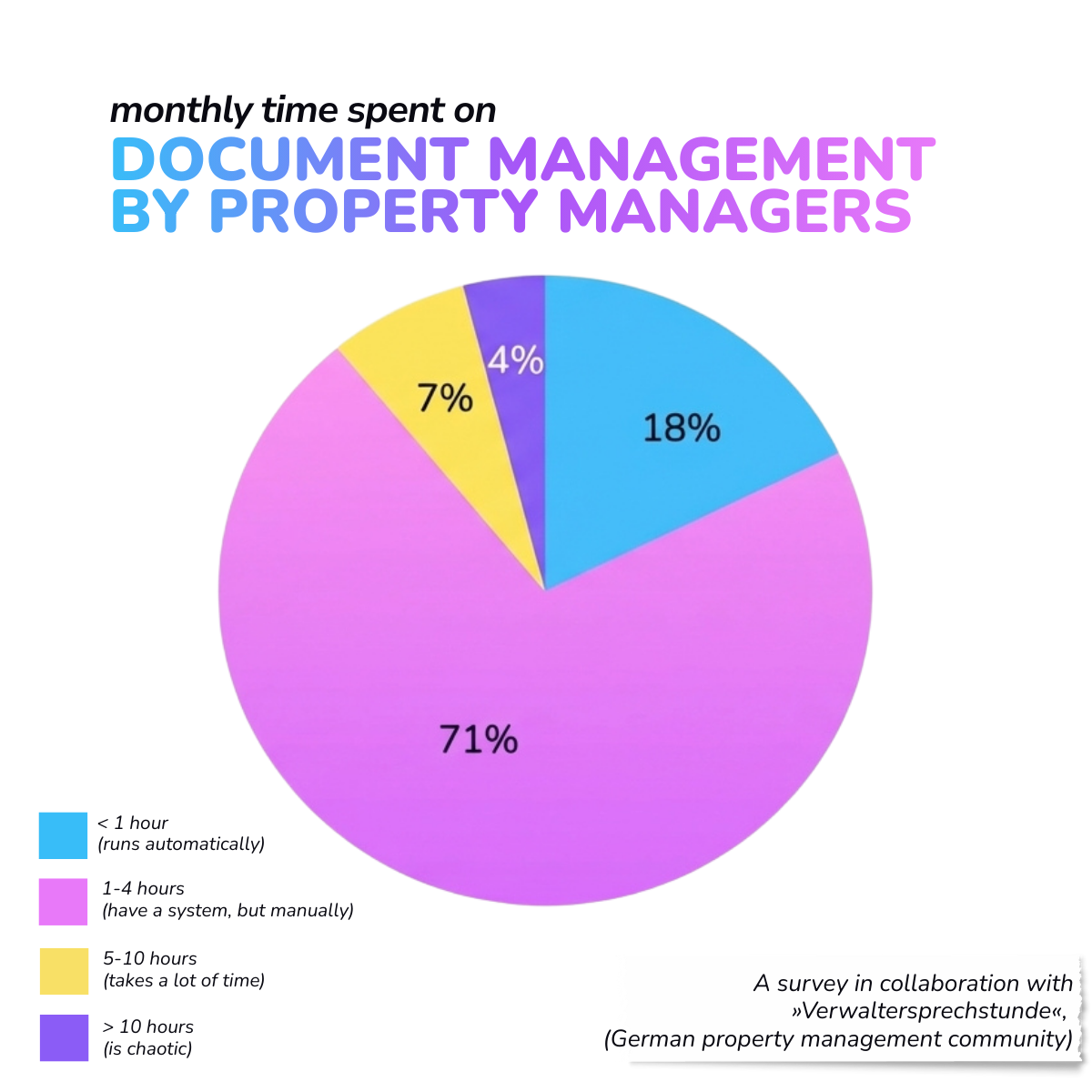
The majority sits in the middle: organized enough to function, but still doing it by hand every single time.
What Does “1 to 4 Hours Per Month” Actually Mean?
Let’s be concrete. A property manager handling 50 units typically deals with:
- Rental agreements and amendments
- Utility bills and service invoices
- Maintenance reports and contractor documents
- Correspondence with tenants, owners and authorities
- Insurance documents, protocols and certificates
Every single one of these arrives with a different name. Often something like scan0047.pdf or Invoice October.pdf or the classic Document (1) final.docx.
Someone has to rename it. Someone has to decide where it lives. And if that person is ever sick, on holiday or simply forgets the convention, the system breaks.
4 hours per month is 48 hours per year. That’s more than a full work week, every year, just renaming files.
And that’s the conservative middle estimate. The 7% spending 5-10 hours monthly lose up to 120 hours per year. The 4% in chaos are losing even more.
Why Manual Filing Creates Downstream Problems
The real cost isn’t just the time spent filing. It’s everything that follows from filing it wrong.
A misnamed document is a dead asset. It exists, but no one can find it. When an auditor, a co-worker or a tenant asks for a specific document, someone now has to go searching. That search can take minutes or hours and in regulated industries like property management, it can also create compliance risk.
This is what we call the Audit Trap: the uncomfortable moment when you know the document exists, but you can’t find it fast enough.
The 18% Who Already Automated: What Are They Doing?
One of the most interesting findings from our poll is that 18% say their filing already runs automatically—spending less than an hour per month on document organization.
We followed up to ask how they do it. One respondent mentioned using an all-in-one solution with integrated document management. Another mentioned DocuWare, an enterprise DMS that costs him around €400 per month.
The common thread: these are specialized, often expensive systems built for property management workflows. They work, but they come with enterprise pricing and typically require migration away from existing cloud storage.
That’s exactly the gap we’re building Filently to fill.
What Filently Does
Filently is an AI filing layer that connects to your Google Drive (with Dropbox and OneDrive coming soon). When a new document arrives, whether via upload, email forwarding or direct sync, Filently identifies what it is, renames it according to your rules and places it in the correct folder.
No prompts. No manual steps. No template to fill in.
The result: every document lands where it belongs, named consistently, from the moment it enters your system.
For property managers specifically, this means rental agreements, invoices and correspondence get organized the moment they arrive, whether you’re in the office or not.
Is This Relevant Beyond Property Management?
Florian Glaab, one of the admins who helped run the poll, made a sharp observation in the comments: this isn’t just a property management problem.
He’s right. The problem doesn’t stop at property management. The same pattern shows up in accounting firms, legal offices, marketing agencies, freelancers and any small business that regularly receives documents from clients, authorities or service providers.
The document types differ. The frustration doesn’t.
What This Means for Your Practice
If you’re in the 71%, you have a system, it works, but you’re still doing it manually. The question worth asking is: what would you do with those 48 hours back?
Not hypothetically. Practically. Which clients would get more attention? Which processes would you finally document? What would you stop deferring?
Filing isn’t a core competency. It’s infrastructure. And infrastructure should run in the background.
The ROI for Property Managers
Let’s make this concrete with numbers.
A property manager in Germany earning €45,000 per year (typical for the industry) has an hourly cost of roughly €27 when you factor in salary, taxes and overhead.
If you’re in the 71% spending 1-4 hours per month manually filing:
- Time spent: 48 hours per year (at 4 hours/month)
- Cost: 48 hours × €27 = €1,296 per year
- Filently Professional: €348 per year ($29/month)
- Net savings: €948 per year
- ROI: 272%
If you’re in the 7% spending 5-10 hours per month:
- Time spent: 120 hours per year (at 10 hours/month)
- Cost: 120 hours × €27 = €3,240 per year
- Filently Professional: €348 per year
- Net savings: €2,892 per year
- ROI: 831%
And if you’re in the 4% experiencing chaos with more than 10 hours per month, the savings are even higher.
This only accounts for the direct filing time. It doesn’t include the downstream costs: time spent searching for misnamed files, the stress of the Audit Trap, or the opportunity cost of what you could do with those hours back.
For most property managers, Filently pays for itself in the first month.
Filently is live with Google Drive. Sign up at filently.com and organize your first 25 documents for free, no credit card required.